



Retaining Walls in Lehi
Serving Utah since 2007. A Utah B-100 licensed general contractor, with a free consultation and line-item pricing.
“I needed a landscape company that could do it all for me so that I only needed to interact with one place. I chose Pitt ”
Retaining Walls in Lehi - Our Project Impact
Serving Utah since 2007, Pitt Landscape has been hired for this work across Lehi.
Project Coverage in Lehi
See where Pitt Landscape has estimated this work in Lehi.
Neighborhood Summary
| Neighborhood |
|---|
Lehi |
About Retaining Walls
Retaining walls across Utah, priced line by line, with the drainage a lasting wall needs. We obtain the permits your project needs.
Customer Reviews in Lehi
I needed a landscape company that could do it all for me so that I only needed to interact with one place. I chose Pitt Landscape to install my yard in Lehi and it was such a great decision. From my first contact with Bryan Capilli to my main contac…
They are very responsive and did a great job! Our backyard turned out amazing!
One estimate, one team
“I needed a landscape company that could do it all for me so that I only needed to interact with one place.” (2024 Google review.) Most of our Lehi projects included planting and new sprinklers, and about a third had design priced in the same estimate.
Project Gallery Overview
Browse real project shots grouped by service. Each card shows a service—tap to explore that service in detail.


Retaining Walls FAQs for Lehi
Common questions about Retaining Walls in Lehi.
Do retaining walls in Utah need a permit?
How long does a retaining wall last?
Can you build a retaining wall on a steep slope?
What is the difference between a boulder wall and a block wall?
Do you offer a free consultation for retaining walls?
How do I know if my retaining wall has a drainage problem?
Will Utah's freeze-thaw cycles damage my retaining wall?
When can I plant trees or shrubs near my new retaining wall?
Retaining Walls for Utah Slopes and Soil
Retaining walls in Utah face hard conditions. Through the winter, water in the soil behind a wall freezes and thaws, cycling pressure that can break down a wall built without good drainage. Clay soils, common in parts of Utah, make it worse.
We build retaining walls as structures, not just decorative features: drainage behind the face, compacted gravel backfill, and geogrid reinforcement on taller walls. We've built them in all four counties we serve, and the rule holds everywhere: drainage first, structure second, looks third.
The work runs from excavation and drainage through wall construction and final grading, and your estimate prices the work line by line.
What's Included in a Retaining Wall Project
A retaining wall project usually includes these phases:
- Site assessment — We look at the slope, soil, drainage and HOA rules before recommending a wall type and height.
- Permits — Many Utah cities require a permit for a wall over about 4 feet, or a shorter one that holds up a load such as a driveway; check with your city. We obtain the permits your project needs.
- Excavation and base preparation — A footing set below your area's frost depth, which varies across Utah, on a firm, compacted gravel base keeps the wall from heaving and settling.
- Drainage system installation — Perforated drain pipe, drainage rock, and filter fabric behind the wall to relieve water pressure.
- Wall construction — Boulder, concrete block, timber or natural stone.
- Backfill and final grading — Clean gravel behind the wall, native soil behind that, graded away from the structure.
- Cleanup and disposal — Excess excavated material is hauled away.
Boulder, Block, and Timber — Which Wall Is Right for You
The right wall material depends on your slope, soil, HOA, and budget. Here's how the common types compare:
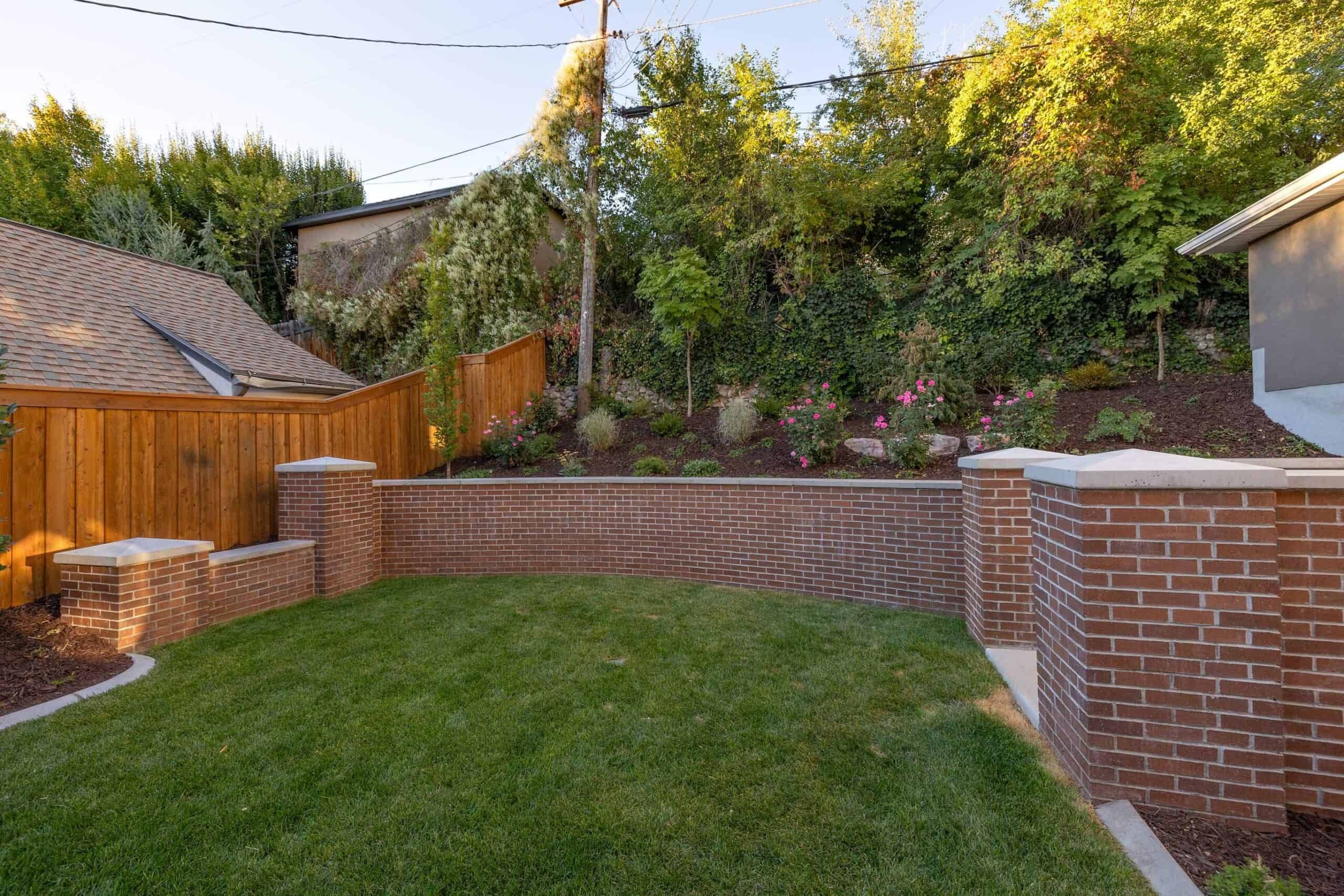
Boulder walls — Natural granite and sandstone boulders, held in place by gravity and mass with no mortar or pins. Very durable, and suited to taller walls where a natural look fits the landscape. They often cost more than block.
Segmental block walls — Concrete block systems give a clean, uniform look and are often preferred in HOA communities. The units lock together, and taller walls add geogrid reinforcement. Walls over about 4 feet often need a permit; check with your city.
Timber walls — Pressure-treated timber is a lower-cost option for shorter walls (under 4 ft) where the natural aesthetic works. Shorter lifespan than boulder or block, even with good drainage.
At your free consultation, we'll look at your slope, soil and HOA rules and recommend the wall type that suits your site and budget.
Drainage: The Key to Any Retaining Wall
Retaining walls often fail not because the wall was weak but because of water pressure: water with nowhere to go builds up behind the wall until it pushes it over or cracks it apart.
A drainage system behind the face relieves that pressure: perforated drain pipe at the base, drainage rock in the first 12 to 18 inches of backfill, and filter fabric to keep soil out of the drainage layer. Longer walls may also get weep holes so water escapes before pressure builds.
When you compare bids, check that each one includes drainage behind the wall.
Our Retaining Wall Process — Consultation to Completion
- Free consultation — A full line-item estimate with up to two revisions. We visit and measure when the scope needs it, looking at the slope, soil, drainage and HOA rules.
- Line-item estimate — Wall type, drainage and materials, with the work priced line by line.
- Permits (if required) — We obtain the permits your project needs. Review times vary by city.
- Excavation and drainage — Excavation, base preparation and drainage. This is the phase that decides how well the wall lasts.
- Wall construction — Boulder placement, block laying or timber installation. Large boulders are set with heavy equipment.
- Backfill, grading, and cleanup — Final grading, seeding or sod as needed, complete site cleanup.
Timing depends on the wall's size and your city's permit review. Ask about timing at your free consultation.
Retaining Wall Cost in Utah
Retaining wall cost in Utah varies significantly based on height, material, drainage complexity, and site access. The main wall types:
- Segmental block walls (2–4 ft)
- Segmental block walls (4–8 ft) — with drainage and geogrid
- Boulder walls — cost depends on boulder size and equipment access
- Timber walls (under 4 ft)
From our records: the middle half of 126 retaining wall projects ran about $14,000 to $56,000 (2021–2026). These are whole-project totals, so they include any other work built alongside the walls.
Larger boulder walls and multi-tiered systems on steep slopes cost more.
The way to know your cost is a free consultation: every site is different enough that per-foot ranges can mislead. We visit and measure when the scope needs it, look at drainage, and give you a full line-item estimate before any work begins.
Ready to Start Your Retaining Walls Project?
Tell us more about your retaining walls project.